Abigail Johnston, a Metastatic Breast Cancer-haver and an active cancer advocate, talks about her experience with clinical trials in the past few years. She explains all that she’s learned while looking for and participating in clinical trials, and she shares valuable recommendations for other cancer patients.
Breast Cancer & Clinical Trials
Before I was diagnosed with Stage IV Metastatic Breast Cancer (MBC) in mid-2017 at the age of 38, I thought clinical trials were a last resort for people at the very end of life. I also thought that a Stage IV diagnosis was automatic death and that catching cancer “too late” was time for hospice. Based on what I knew then, I thought that clinical trials were hopelessly complicated and difficult to access and enroll in. I wasn’t thinking about researching or looking into clinical trials at all, mostly because I was just surviving.
I’ve learned a lot since 2017!
“There is a large variety of clinical trials with very different criteria that are available to all stages of cancer.”
The first thing I learned right away is that there is a large variety of clinical trials with very different criteria that are available to all stages of cancer. I participated in a trial in the first year of my treatment that was looking at the efficacy of genomic testing. I didn’t take any medicine, I didn’t fill out any complicated forms or reported symptoms over time, they just tested the tumors that had previously been removed from my left breast. I received important information, information that has led to my second line of treatment. That experience showed me that not all trials are designed the same or have the same goals.
Since that experience, I’ve read a lot of studies. I’ve seen the design of trials and their outcome and I’ve learned even more that the goals and end points of trials make a huge difference in how the trial is designed. I didn’t know that there was a difference in looking at Progression Free Survival (PFS) and Overall Survival (OS) (see these terms and more in ancora.ai’s glossary) and what that means to the people in the trial and the target audience for the medication themselves. I didn’t understand how important it was and is that scientists see and know the people who will benefit from their labors. I didn’t understand how long it takes for medication to go from conception to market (10-13 years).
“I’ve learned that my doctor doesn’t know about all of the clinical trials.”
The second thing I’ve learned about clinical trials is that my doctor doesn’t know about all of them. This was quite an astonishing bit of knowledge and, at first, it eroded my sense of trust in her. Then, I realized that I had to put my doctor into her correct context, that her focus had to be on my treatment and managing my treatment. This meant that she didn’t always have the time or ability to stay abreast of all the trials and research goals and the details of eligibility, especially specific to me since I’m only one of her patients.
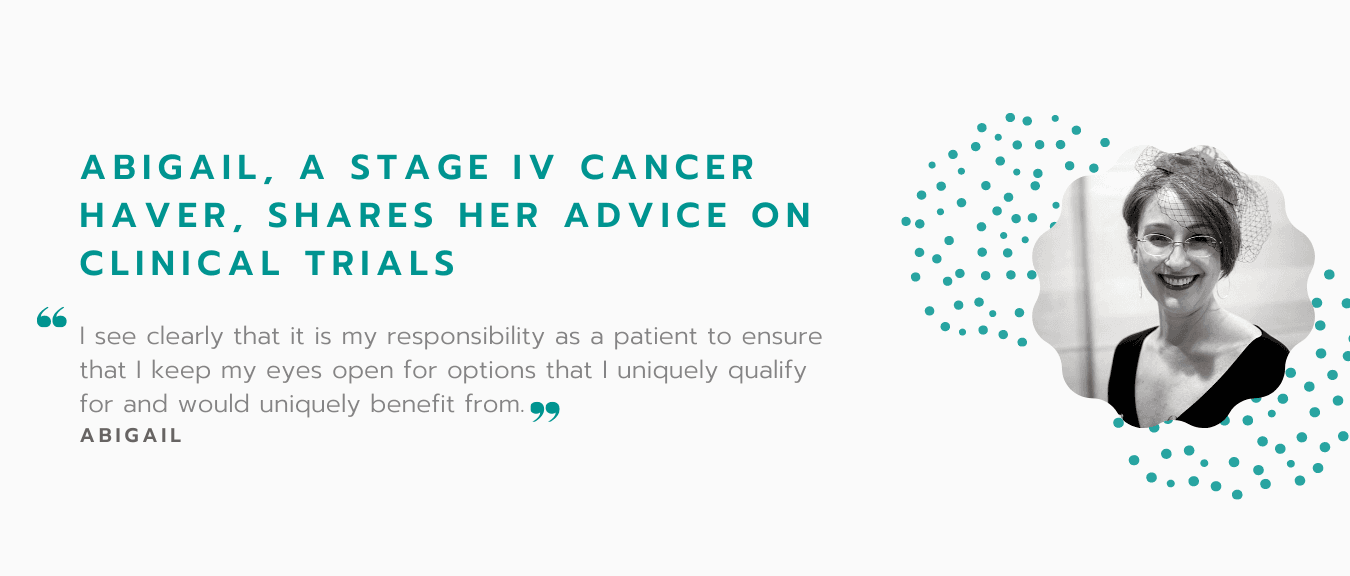
“I see clearly that it is my responsibility as a patient to ensure that I keep my eyes open for options that I uniquely qualify for and would uniquely benefit from.”
That’s not to say that she doesn’t work hard to stay current on the research, it’s just that I’m one of her many patients and I know the subtype of the rogue cancer cells in my body better than she ever could. My story and my details are in my chart, but no one knows it better than I do. While I live in Miami, Florida, my doctor couldn’t know all of the people I know in other states, who might afford me a place to stay if I decide to pursue a study in another place. And so, I see clearly that it is my responsibility as a patient to ensure that I keep my eyes open for options that I uniquely qualify for and would uniquely benefit from.
The third thing I’ve learned is that trials don’t have to be complicated and difficult to access. There certainly are barriers for patients to be able to participate in trials, yet there are solutions for finding, enrolling in, and completing trials, if we look. There is a whole industry around the pharmaceutical companies that run the trials and understanding the various options and assistance is key.
So, what do I take away from all this knowledge?
Here are my recommendations, as a patient and patient advocate, for anyone who wants to participate in a trial:
- Find a trial finder or website that you like and visit it regularly. Any patient can search the full database at cancer.gov, which can be hopelessly confusing and cumbersome, but I prefer those companies like Ancora.ai that make it a little easier to search. Also, one of the dear friends I’ve made in the MBC community has her own website called TheStormRiders.org where she directly assists individuals with locating trials. New trials are added all the time, so having a resource to help sort through all of the data is key.
- Any time a researcher is talking about their research on a webinar or conference, go and listen. Researchers give valuable and key verbiage during these presentations that help patients to know what to look for. Watch for talks that are specific to your subtype or the type of metasteses you have as these specifics are usually embedded in the criteria for a trial.
- Any time a fellow cancer-haver you know participates in a trial, ask them about it. Get the pros/cons, find out what they would have done differently. This information can be extremely valuable and can guide you to cull the results of a search for trials. Anything that can help you hone in on a specific aspect of a trial that is uniquely perfect for you, is valuable.
- Talk to your doctor about what you are thinking and researching. I share trials and ideas with my medical oncologist regularly. I send them to her via email and sometimes I get a response, sometimes we talk about it and sometimes she doesn’t get around to it. What I know is that she reads what I send her, she knows that I’m thinking about and researching options for me and she is too.
- Share share share. Any time you know something or read something or participate in something, share with other cancer havers. It’s so important that we empower and educate each other since not everyone has the same time or energy or ability that are necessary to research and assimilate this important information.
The only other thing I’d add before I close is about that friend at TheStormRiders.org. Christine Hodgdon and Julia Maues developed the GRASP program in 2019, which stands for Guiding Researchers and Advocates towards Scientific Partnerships. This program combines patient advocates, researchers and doctors to view the posters during scientific conferences to learn from each other. This is the best example I’ve ever seen of how we all do better when we collaborate and connect as human beings first.
About the Author:
Abigail is a daughter, mother, wife, and attorney who was diagnosed with metastatic breast cancer in June of 2017, close on the heels of an early stage diagnosis in March of 2017. In reality, the breast cancer had already spread to Abigail’s bones before she felt the lump in her breast. The first few months after her diagnosis were a whirlwind and full of many profound changes, but Abigail soon found her footing and started her blog “No Half Measures,” where she talks about whatever comes to mind, within the lens of her Stage IV diagnosis. Abigail’s boys, Liam and Malcolm, who were nearly 2 and nearly 4 at the time of her diagnosis, along with her husband, Elliot, make their own appearances in Abigail’s advocacy since it truly is a family affair. In 2017, Abigail discovered that she inherited the ATM mutation and further testing has revealed other somatic mutations; this is now her focus of research and she bugs her doctors regularly with articles and new information.
For Abigail, advocacy is a whole life endeavor and she never does anything halfway. Abigail works with Metavivor as a Peer to Peer Advocate, with Living Beyond Breast Cancer as a Hear My Voice Advocate, with After Breast Cancer Diagnosis (ABCD) as a mentor, with the 305PinkPack as a volunteer and moderator of a support group with her Dad, and she started her own non-profit, Connect IV Legal Services, to recruit attorneys to do pro bono legal work for Stage IV metastatic breast cancer patients. Abigail is an active member of her local support group, Y2B2 which is geared towards younger women with all kinds of cancer and is a co-administrator of a metastatic breast cancer community, Living Metastatic One Day at a Time, where she helps to organize the “Sister Buddy” program so that no member feels isolated or alone. Outside of cancer advocacy, Abigail serves as a room mom for her boys’ teachers and is a board member of her local PTA, serving as a Parliamentarian.
She can be found via social media on her blog, “No Half Measures,” as well as Facebook, Instagram, and Twitter. Outside of her cancer life, Abigail enjoys spending time with her family and cat, scrap-booking, cross-stitching and dreaming up more ways to experience life with her boys.